
Growing Wellness, One Plant at a Time
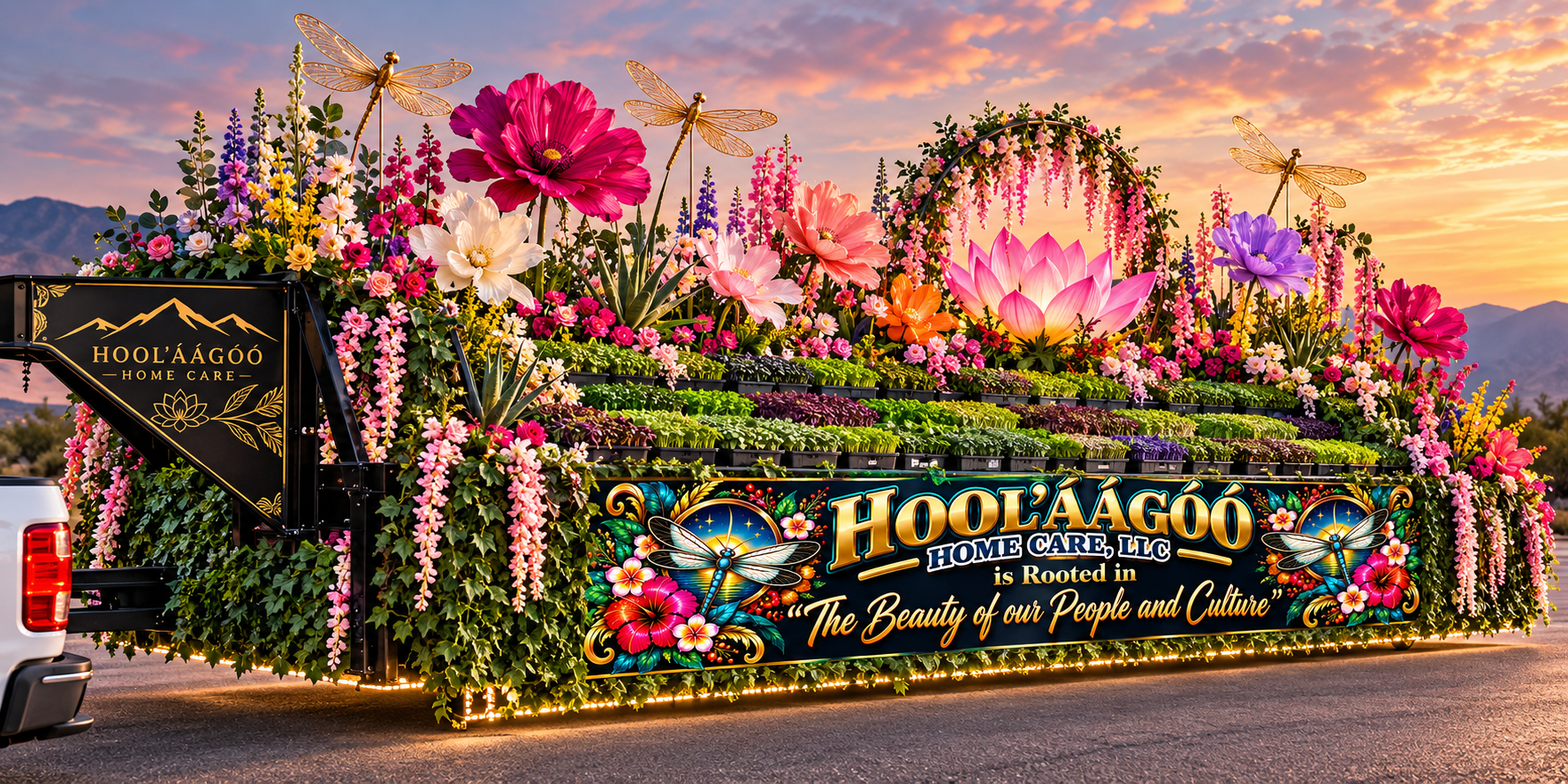
Hool’áágóó Home Care & Sassy Radish Collaborative for 2026 WESTERN AGENCY PARADE
1,400 Microgreen Plants • 1,400 Opportunities to Grow Wellness
At the Tuba City Parade, Sassy Radish and Hool’áágóó Home Care are coming together to share something small that carries a much bigger purpose.
We are giving away 1,400 living microgreen plants to elders, families, and community members as a celebration of health, culture, community, and our connection to the foods that nourish us.
Meet Jessie Bennett & Sassy Radish
Sassy Radish was created by Jessie Bennett with a passion for bringing fresh, nutrient-rich foods into Native communities and helping people rediscover the power of growing food close to home.
Jessie’s vision goes beyond growing microgreens.
Her goal is to educate, inspire, and increase access to nutritious foods, particularly for our elders and Native communities. Through Sassy Radish, she hopes to help people understand how even a small amount of space can be used to grow fresh food and how growing our own foods can become part of a larger movement toward healthier and more food-sovereign communities.
Why Microgreens?
Microgreens may be small, but they are packed with flavor and nutrients.
They can be grown in small spaces, harvested quickly, and added to many everyday foods. More importantly, a living microgreen plant gives someone the opportunity to participate in growing and harvesting their own food.
For an elder, a child, or an entire family, that little plant can become a conversation:
Where does our food come from?
What can we grow ourselves?
What knowledge can we share with the next generation?
Growing Food Sovereignty
Food sovereignty is about more than having enough food.
It is about communities having greater knowledge, choice, access, and participation in the foods that sustain them.
For Native communities, growing food can also strengthen relationships between land, culture, health, family, elders, and future generations.
We hope these 1,400 plants encourage 1,400 conversations about growing, nutrition, traditional knowledge, and what is possible within our own homes and communities.
Rooted in the Beauty of Our People and Culture
For Hool’áágóó Home Care, caring for elders has always meant more than providing services.
Our elders carry our stories, language, teachings, humor, history, and knowledge. Supporting their wellness also means creating opportunities for connection, dignity, independence, and community.
That is why this collaboration with Sassy Radish fits so beautifully with our 2026 parade message:
Hool’áágóó Home Care is Rooted in
“The Beauty of Our People and Culture.”
Together, Sassy Radish and Hool’áágóó Home Care are planting something we hope continues long after the parade is over.
Grow it.
Harvest it.
Share it.
Teach someone else.
You Received a Microgreen Plant — Now What?
Keep your plant in a bright location and water it daily. harvesting is simple clip close to the roots (wash/rinse and add to your foods).
When it is ready, approximately 3 to 4 inches harvest your microgreens and enjoy them with foods you already love — sandwiches, salads, eggs, soups, wraps, or other meals.
And when you finish?
We hope this little plant inspires you to grow something again.
Growing wellness. Sharing knowledge. Nourishing our elders. Strengthening our communities.
The Origin Story of The Sassy Radish
Before The Sassy Radish, there was a farm.
And before there was a farm story, there was a peach.
As a child, I spent part of my young life on our family farm in Shiprock, New Mexico. Almost everything we grew helped feed our family and the families who purchased our produce. Indian corn, squash, melons, grapes, strawberries, peaches, and other foods were part of our everyday lives.
Some of my fondest memories are of my grandmother's peach trees. I remember being able to walk outside, pick a peach, and eat it. There was no mystery about where my food came from. It came from our land. It was grown by people I knew. It was harvested when it was ready. And it tasted like what it was supposed to taste like.
Then we left the farm.
Years later, I went into a store and saw a beautiful peach. It was plump. It had beautiful color. It looked perfect. I was excited to eat it because it reminded me of the peaches I remembered from home. I brought it home, washed it, and took a big bite.
It was firm. It had almost no flavor. And to me, it was one of the most disappointing peaches I had ever tasted.
It looked ripe. But it wasn't what I remembered.
That peach made me stop and wonder: How can something look so good and taste so different?
That question stayed with me. And eventually, it became much bigger than a peach.
Looking Beneath the Surface
As I grew older, I began learning more about our food system. I learned about food deserts and how difficult it can be for communities to access fresh, nutritious food. I learned about how food is grown, harvested, transported, stored, processed, and eventually placed on grocery-store shelves.
I began thinking about how different that was from the farm I remembered. On the farm, we didn't have to wait for food to travel hundreds or thousands of miles. We walked outside. We picked it. We ate it.
And I began wondering what happens to our health, our knowledge, and our relationship with food when we become disconnected from the ability to grow it ourselves.
The more I learned, the more questions I had. And eventually, those questions led me back toward the land.
Remembering What We Already Knew
As an Indigenous person, I also began looking at our food story through the history of our people. Long before grocery stores, our communities had sophisticated systems for growing, gathering, hunting, preserving, preparing, trading, and sharing food. Knowledge was passed from one generation to another. Our relationships with food were connected to land, family, culture, seasons, community, and survival.
Colonization and federal policies disrupted many of those relationships. Indigenous children were forcibly removed from their families and communities and sent to boarding schools. Historical records document cultural suppression, separation from traditional lifeways, inadequate nutrition, abuse, and deaths associated with the boarding-school system.
The consequences of those disruptions did not simply disappear when the schools closed. The loss of land, traditional foodways, access to nutritious foods, and intergenerational knowledge became part of a much larger story about health and food security in Native communities.
I began to understand that the challenges many Indigenous communities face today did not begin with our generation. That realization changed the way I thought about food.
I stopped seeing food simply as something we eat. I began seeing food as knowledge, connection, health, culture, independence, and sovereignty.
My Own Health Became Part of the Conversation
After I had children, I eventually developed type 2 diabetes. I cannot say that one particular food or one particular thing caused it. But I began thinking much more seriously about how the foods we have access to, what we eat, and the conditions surrounding our food system can affect our health.
I thought about the foods I grew up eating. I thought about the foods available to many of us now. And I thought about how much knowledge can be lost when generations grow up without the opportunity to grow their own food.
That strengthened my desire to learn. Not only for myself and my family, but for my community.
From a Farm to a Tray
For a long time, I dreamed about having a farm again. I wanted dirt. I wanted growing space. I wanted to produce food. But life doesn't always give us the exact piece of land we imagine.
So I learned to start smaller. Much smaller.
I discovered that I could grow nutrient-dense food in a tray. That led me to microgreens. Microgreens changed the way I thought about what was possible.
You don't necessarily need acres of land. You can start with a tray. Or a few four-inch pots. A little soil. Some seeds. A window. A porch. And someone willing to teach you.
Some microgreens can be ready to harvest in about a week, while others take longer. That speed and accessibility opened a door for me.
I realized that microgreens could be more than a crop. They could be a teaching tool. They could help someone learn how food grows. They could give an elder something living to care for. They could give a child the chance to watch a seed become food. They could give a family an opportunity to grow something together. And they could give someone without a large farm a place to begin.
Then Came the Radish
Somewhere along this journey, there was a little radish. It started as a microgreen. I harvested all of its brothers and sisters. But one little plant survived.
It wasn't quite ready to be harvested, or perhaps it simply managed to escape the harvest. Either way, I gave it another chance. I moved it into another container with more soil and let it continue growing.
Eventually, that little microgreen became a full-grown radish. And it had personality. A LOT of personality.
It was a little bit ridiculous. A little bit cheeky. And definitely... sassy.
That little radish became the inspiration for the name:
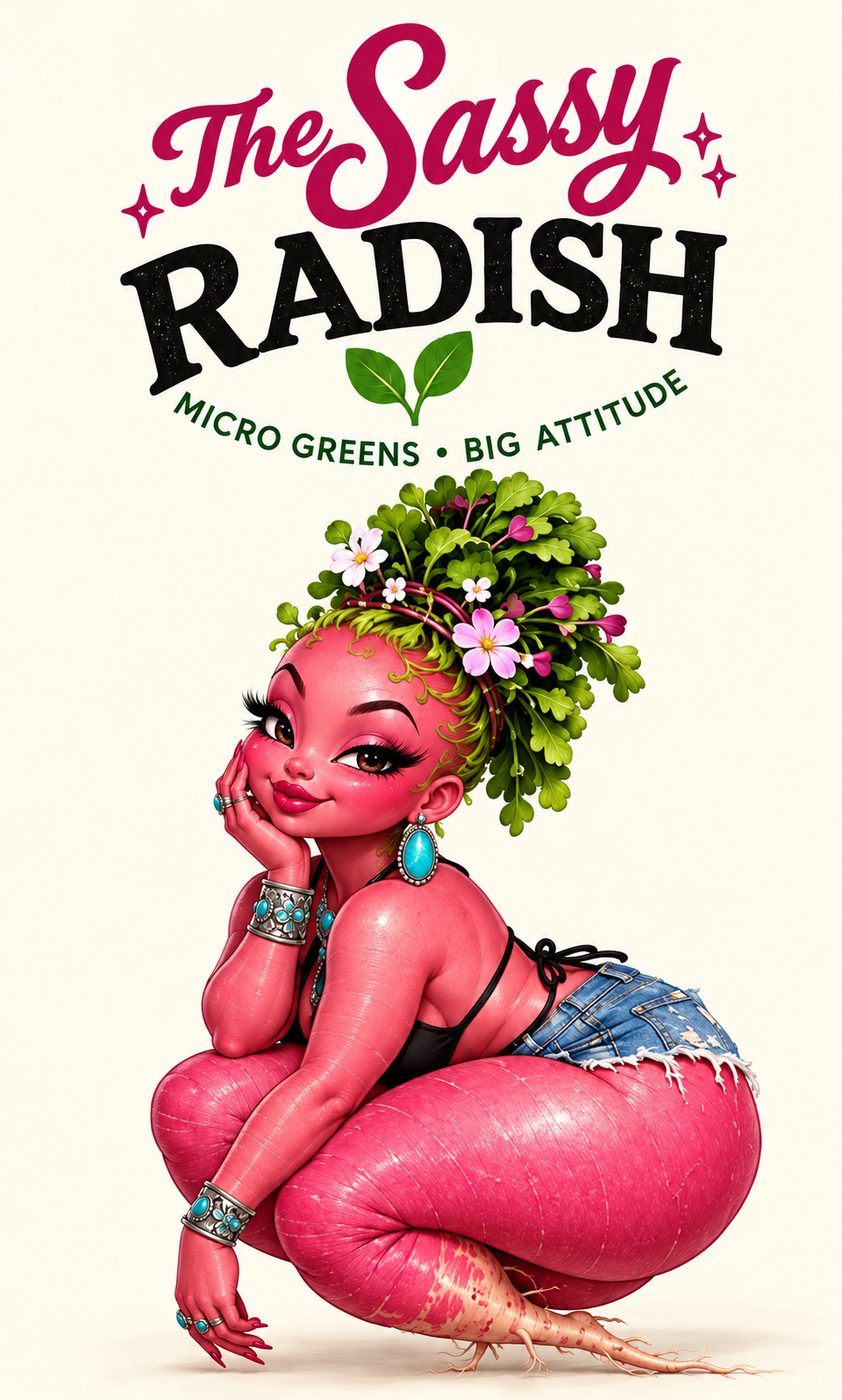
THE SASSY RADISH
There was another connection hiding there too. As a child, I loved Fraggle Rock, and I remembered its wonderful underground world and all those radishes.
So somehow, a childhood memory, a little radish, and my desire to grow food all found each other. What began as a funny little name became a business. And the business became something much bigger.
The Part of the Plant That Doesn't Have to End
One of the things I love most about growing this way is that harvesting doesn't always have to be the end.
I grow individual four-inch pots inside a 10-by-20 tray, with 18 pots fitting inside one tray. This allows me to grow a variety of plants together instead of putting an entire tray into one crop. It also gives me another advantage. If something goes wrong with one plant or one variety, I can remove that individual pot instead of losing everything in the tray.
But the real magic happens after harvest. Sometimes little plants remain. Maybe they weren't tall enough to harvest. Maybe a seed germinated later than the others. Maybe one tiny plant simply survived.
I don't necessarily see those plants as leftovers. I see them as survivors.
I can take them out of their small pots and give them more room, more soil, and another opportunity to grow. That little microgreen can become a mature plant. A mature plant can produce more food. And eventually, it can produce seed.
Those seeds can be collected, properly dried and stored, planted again, or shared with someone else.
So the cycle becomes:
Seed → Microgreen → Harvest → Survivor → Mature Plant → Food → Seed → Share → Grow Again
That is one of the things I love most about growing food. It doesn't have to be a straight line. It can be a circle.
One Little Plant Can Carry Something Forward
A small pot may contain many seeds. But sometimes, only one needs to survive.
One seed can germinate. One tiny plant can survive the harvest. It can survive being transplanted. It can survive insects, weather, pests, and all the other challenges that come with growing.
And eventually, that one plant can produce more food and more seed.
That feels like resilience to me. It reminds me that survival isn't always about being the biggest or strongest thing in the garden. Sometimes it is simply about making it through.
One little plant can make it. And when it does, it can provide something for someone else.
That is what I see when I look at those little survivors. Not waste. Not leftovers. Possibility.
Growing Food Sovereignty
This is where The Sassy Radish became about much more than microgreens.
To me, food sovereignty is about having knowledge, access, choice, participation, and connection to the food that sustains us.
It means knowing how to grow. Knowing how to save seed. Knowing how to share seed. Knowing how to preserve food. Knowing what grows where we live. Learning from our elders. Teaching our children. And sharing what we learn with one another.
I don't believe we have to choose between traditional knowledge and modern growing techniques. We can learn from many sources while still asking:
What works for our communities? What works for our land? What can we teach one another? And: What can we grow ourselves?
For me, food sovereignty doesn't have to begin with a thousand acres. Sometimes it begins with one seed. One pot. One tray. One person. One conversation.
From One Generation to the Next
That is what I hope The Sassy Radish can become.
Not simply a farm. Not simply a business. But a way of sharing knowledge. A way of helping people discover that growing food is possible. A way of reconnecting people with the food on their tables. A way of encouraging people to save seed and share seed. A way of giving elders an opportunity to teach. A way of giving children an opportunity to learn. And a way of helping our communities grow more of what nourishes us.
Because when we grow food, we are not only growing something to eat.
We are growing knowledge. We are growing confidence. We are growing connection. And perhaps we are growing something our grandchildren will remember.
1,000+ Plants. 1,000+ Possibilities.
That brings us to the next chapter.
For the 2026 Tuba City Parade, The Sassy Radish and Hool’áágóó Home Care are coming together to give away 1,000+ living microgreen plants.
One thousand plants. But I don't really see it as 1,000+ plants. I see 1,000+ opportunities.
An elder might take one home. A child might watch it grow. A family might harvest it together. Someone might taste a microgreen for the first time. Someone might transplant the survivor into a garden. Someone might watch it become a mature plant. Someone might save the seed. Someone might share that seed. And someone else might begin again.
That's how knowledge moves. That's how food systems can begin rebuilding. That's how one small thing becomes something larger.
This Little Plant Has a BIG Story
The plant you're holding is part of my story.
It began as a seed. Someone cared for it. Someone grew it. And now it is in your hands.
You can harvest it. You can eat it. But you can also let part of it keep growing. Give it more soil. Give it room. Watch what happens.
Maybe it will become a mature plant. Maybe it will produce more food. Maybe it will produce seed. Maybe those seeds will grow again. And maybe you'll share them with someone else.
Grow it. Harvest it. Eat it. Replant it. Save it. Share it. Teach someone else.
Because food sovereignty doesn't have to begin with a thousand acres. Sometimes it begins with one little plant.
We Are Still Growing
When I think about that peach now, I realize it gave me something much more valuable than a good meal.
It gave me a question. That question led me back to the farm. The farm led me to the tray. The tray led me to the microgreens. The microgreens led me to one little surviving radish. And that radish became The Sassy Radish.
Now that little idea is growing into something I hope can reach other people.
Maybe that's what “Unripe” really means to me. Not that something is finished. But that there is still more growing to do.
More to learn. More to remember. More to teach. More to plant. More to harvest. More to share.
Because we all deserve more than unripe peaches bought from the store.
We deserve the opportunity to know our food. To grow our food. To share our food. To learn from our elders. To teach our children. And to grow something worth passing on.
One seed at a time.